
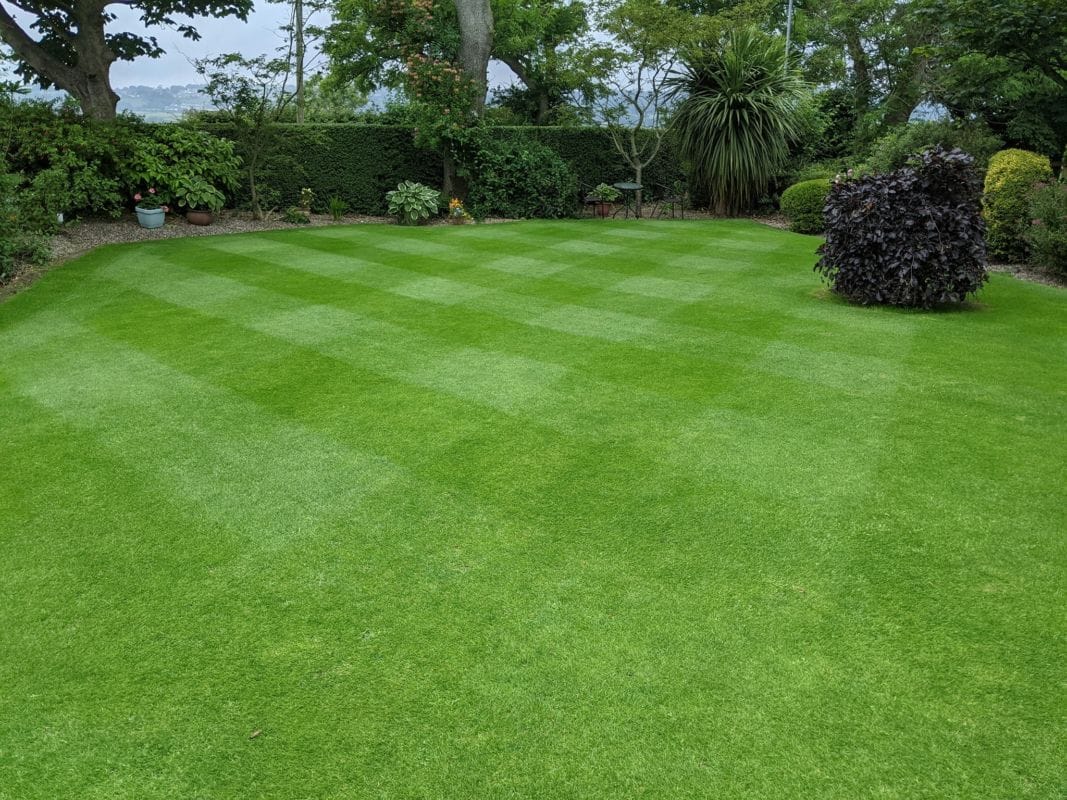
We only overseed and topdress lawns for clients who have been with us for 3 to 6 months. We don’t take it on as a one-off job.
Why overseed a lawn?
Grass doesn’t live forever. Individual grass plants only last a few years, and wear, shade, dry summers and pets all take more of them out along the way. If fresh grass isn’t coming through, the lawn slowly gets older, thinner and weaker, and moss and weeds are quick to claim the space.
Overseeding is sowing new seed into the lawn you already have, and it’s one of the best things you can do for it:
- Thickens thin and patchy areas before moss and weeds move in
- Keeps the lawn young. New plants are stronger, greener and more vigorous
- Introduces better grass varieties than the lawn started with
- Builds the kind of density that copes with wear, drought and disease
Why add topdressing over the seed?
Seed scattered on top of a lawn mostly goes nowhere, or feeds the birds. To germinate, seed needs to touch soil and stay damp. That’s exactly the job topdressing does:
- Tucks the seed in against the soil, the seed-to-soil contact everything depends on
- Holds moisture around the seed while it germinates
- Hides it from the birds
- Smooths out small dips and bumps while we’re at it
- Improves the soil your lawn is rooted in, year on year
Two jobs, one visit. The topdressing gives the seed its best possible start, and the new grass knits the topdressing into the lawn. It’s also the same job greenkeepers do on golf greens, and a big part of why greens feel so smooth and firm underfoot.
Why we use screened, bagged topsoil and compost
The material matters as much as the method. When we topdress, we use screened topsoil or compost that comes in sealed bags, not loose bulk bags.
Screened means the material has been passed through a fine mesh. No stones, no lumps of clay, no roots, and far less weed seed. It spreads evenly, works down into the grass, and gives the seed a clean bed to get going in.
Bulk bags are cheaper by volume, and that’s the trade-off. But loose bulk material is variable. You get stones that catch the mower, lumps that smother the grass, and weed seed you can end up fighting for years. It also sits out in the weather, and wet material spreads in clods rather than an even layer.
Bagged screened material costs more per square metre. We think it’s the wrong place to save money though. Topdressing goes straight into the surface of your lawn, and cheap material puts problems in that cost far more to get back out.
When is the best time?
There’s a small window in spring to overseed and topdress, once the frosts have passed. That window seems to get smaller each year though, as May is increasingly turning very dry. We can still do it in spring, if you’re prepared to water the lawn.
Late August, September and October are the best times. It’s generally damper, and the soil is still warm from summer, which is exactly what new seed wants.
Aftercare: the bit that decides everything
The first few weeks after seeding make or break the job. The seed needs kept damp, the new grass needs left alone while it establishes, and the first cuts need to be high and gentle. Once the new grass has been mown a couple of times, feeding takes over, and that’s already built into your seasonal programme.
Watch how it’s done
Straight from our YouTube channel. This is the work, step by step, on real lawns.
The complete lawn makeover, start to finish
Topdressing, overseeding and aftercare on one medium back garden.
The secret to a thick lawn starts here
10 stupid mistakes to avoid when overseeding your lawn
Beginner’s guide to overseeding
The ultimate fix for a bumpy, uneven lawn full of moss
90% moss and deep ruts. If your lawn is bumpy, do this now
The one step people skip
What to cover new seed with
A partnership in professional lawn care
Great lawns aren't created by chance, and they certainly aren't built on mass-market formulas. They're built in partnership.
We work in partnership with you. We handle the treatments and the complex science of soil health. You manage the mowing and keep things right between visits.
We intentionally limit our intake. It's the only way to give every lawn the attention this partnership takes.
Check we cover your areaOur customers say
Malone Road, Belfast
Stranmillis, Belfast
Knock, Belfast
We work in partnership with our clients to create beautiful lawns
Because of our work on social media, we get far more enquiries than we can take on. We only take on a small number of new lawns each year, and it takes three short steps to find out if yours can be one of them.
1. Check your postcode
Pop it into the checker to see if you are on our route.
2. Submit your lawn details
Fill in the short form so we can review your garden.
3. We'll be in touch
We'd love to help everyone, but our limited capacity means we can't take on every garden. If yours is a good fit, we'll get in touch.
iGrow Carpet
If we don't cover your area or are fully booked, check out iGrow Carpet. This is my own range of lawn care products, featuring a full free online learning hub, masterclasses, and tools to get the most from your lawn.